' [Birth Mother] First Mother Forum: egg donation
Showing posts with label egg donation. Show all posts

Thursday, March 6, 2014

Even in 'modern families' the need to know biological heritage

Jane
Opponents of gay marriage often raise the specter of gays raising children they adopt or create through "modern fertility techniques" claiming that gays raising children would lead to the breakdown of the family, which would lead to the disintegration of civilization. Well, of course gays have been raising children long before recorded history. Those Greeks doing it in bath houses were often married with children. And gays like my late sister Helen married members of the opposite sex, had children, divorced, and taken up with a same-sex partner.

 Since the 1970's gays have adopted children both from foster care and as newborn infants. They have also created children through sperm and egg donations, IVF and surrogacy. With courts striking down gay marriage bans, it's likely that more gays will marry and acquire children. The critical question

Wednesday, June 5, 2013

Exploiting first mothers, then and now

(Jane, second row on the far right)
Babies come from mothers who don't want them was the shocking message of an adoption agency advertisement from the 1940's. The agency guaranteed prospective adoptive parents that babies would be matched to them not only in appearance, but also in intelligence. And unbelievably, prospective adoptive parents were also promised a "one year return policy" if the baby didn't fit into their family.

Ann Fessler's film, A Girl Like Her, includes this and other videos to present pictorially the ugly truth about adoption in the mid-twentieth century. As the videos of happy housewives dancing in their oh-so-modern kitchens and teens in full skirted strapless prom dresses switch to pictures of soldiers in Vietnam and war protesters, off screen first mothers tell their stories of loss without redemption.


Monday, April 16, 2012

Would-be Egg 'Donor' imagines a child growing up with genetic strangers


Lorraine
SEE UPDATE AT END OF POST
Why would you not donate your eggs?  The profit is great--$10,000!--the risk seems at first blush small (if inconvenient), and you seem... magnanimous. So why not do it?

An awareness of what is lost when there is not shared blood led one young woman, Simi Lampert,  to change her mind about selling her eggs. Calling her a donor is such BS the head spins. Yet what she became aware of as she considered marketing her eggs is exactly what is ignored in adoption: how being with genetic strangers marks one as different. The other. Not from the same stock. Together but separate. From "Why I Couldn’t Donate My Eggs" on Tablet, A New Read on Jewish Life:

"My siblings and I were raised by my mother, who was an only child, and my stepfather. One of the things about my childhood that’s always bothered me, something I wish could be different, is that my step-cousins never really felt like my cousins. (Emphasis added.)

Sunday, October 2, 2011

How the media encouarges separation of mother and child

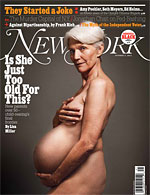
The cover story of New York magazine last week was titled: "Is She Just too Old for This?" and showed a freakish and obviously photo-shopped picture of a very pregnant woman in her, hmmm...late sixties. The story eventually went on to say that old motherhood is great and as long as it's possible, go for it, if that is what you want. There are a lot of bothersome issues about having kids at an age that they will be taking care of senile parents while they are in college or right after, but that's not what caught my attention. Here's one issue that did:
"Among women over 40, birth rates have increased. Among women ages 45 to 49, they've risen 17 percent....Women over 45 who want to carry their own babies most often use donor eggs...."

Friday, August 20, 2010

Maness Moms Equal Fatherless Children, Part 2

A further clarification regarding donor children, and the research of the Institute for American Values, after Jessica left a comment at the previous blog: Manless Moms Equal Fatherless Children.  (It was too long to be merely a comment.)

We know that the ideal two-parent family is impossible for everyone; we also believe that women today ought to be given all the help they can to be able to raise their children, with or without fathers. We do not encourage adoption except in extreme cases, and then never with sealed records. We at First Mother Forum believe that whenever possible children should full knowledge of who each parent is. This is an unalienable, unassailable right, and to deny it to anyone is to commit a grave moral failing.

Monday, May 24, 2010

Egg Donor or Egg Seller? Fulfilling Another Woman's Dreams or Filling Your Pockets


Trouble, trouble in baby-making land reported The New York Times on May 10, “Payment Offers to Egg Donors Prompt Scrutiny”. Apparently them gals who went up north for some educatin’ graduated with something more than a diploma written in Latin. Seems a few took a class or two in economics and put it to good use: charging up to $50,000 for their ivy-coated eggs, a price women with old rotten eggs are more than willing to pay. Men are also willing to part with big bucks to become daddies, hiring surrogates to tote upscale eggs blessed with their sperm.

Well, knock me over with a feather. I thought that women risked their health, their own fertility, even their lives, taking a lot of hormones to stimulate their bodies to pop out eggs for perfect strangers out of some sort of "love" for mankind. That these women do it for money (enough to pay for about half a year at Harvard) puts them right up there on the scoundrel list along with Wall Street barons fleecing low income would-be home buyers.

The egg business may soon surpass the adoption business. About 10,000 families each year acquire a baby through donated eggs, almost as many as acquire babies through adoption, 14,000. According to the Times,
“Dr. Aaron Levine, an assistant professor of public policy at the Georgia Institute of Technology examined more than 100 egg donation ads from 63 college newspapers. He found that a quarter of them offered compensation exceeding the $10,000 maximum cited in voluntary guidelines issued by the American Society for Reproductive Medicine, a professional association.

"In addition to limiting compensation, the society’s guidelines forbid paying additional fees to egg donors for specific traits. But the study found that every 100-point difference in a university’s average SAT scores was correlated with an increase of more than $2,000 in the fees advertised for potential egg donors in the campus newspaper.

"The guidelines state that payments of $5,000 or more above and beyond medical and related expenses ‘require justification’ and that payments above $10,000 ‘are not appropriate.’ Ads in newspapers at Harvard, Princeton and Yale promised $35,000 for donors, Dr. Levine found, while an ad placed on behalf of an anonymous couple in The Brown Daily Herald offered $50,000 for ‘an extraordinary egg donor.’"
The article doesn’t say what a Columbia grad could garner, hopefully not enough to entice my youngest daughter, a lioness diplomate, from selling her eggs. On the other hand as the contributor to half her DNA, maybe I could get a cut, sort of like a royalty. I can see the ads: Fund your retirement from your daughter’s eggs.” That ought to give SAT prep classes a boost.
"'The concern is that some young women may choose to donate against their own best interests,’ Dr. Levine said. ‘They’ll look at the money on offer and will overlook some of the risks.’" [It seems to me and Lorraine that donating eggs is always against a woman’s best interests.]
The American Society for Reproduction Medicine’s reason for limiting compensation to donors may not be based entirely on concern for these bright, attractive young women whose eggs command high prices. Back to Econ 101, more money to donors means less money to doctors, egg merchants, and the rest of the industry promising parenthood to those who cannot or do not choose to have children naturally.

Who’s Buying?
With many women today putting making money ahead of making babies, there’s no end to Hollywood stars, political wives, and others seeking motherhood in their late 40’s, 50’s, and even 60’s. Recently we learned that John Travolta and his wife Kelly Preston, still grieving over the loss of their son Jett, are expecting a baby. It’s safe to assume that 47 year old Preston didn’t get pregnant au naturel. She may have had her eggs frozen when they were still viable (but that’s unlikely) or she may have purchased some eggs (more likely), perhaps requiring that the seller have some Grease in her DNA or at least be a Scientologist.

If Travolta and Preston are having a “replacement” baby, they won’t be the first. After the death of their son Wade, former senator and presidential candidate John Edwards and his wife Elizabeth decided more children would bring joy back into their family. Emma Claire was born in 1998 when Elizabeth was 48, and Jack was born in 2000 when she was 50. (Subsequently John added to his lineage through a more loving way, albeit unwillingly, when 43 year old Rielle Hunter gave birth to his [initially unacknowledged] daughter, Quinn.) 

Real Risks
On the serious side, whether for love or money, egg donation presents substantial risks. Besides the physical risks (gory details below), there is the likelihood of psychological distress when the donor fully realizes that there is somebody “out there” carrying her genes. Like women who surrendered babies in closed adoptions, donors may find themselves scanning faces in shopping malls looking for people who resemble them. Unless donor and child know each other, there is a risk that the donor’s children and the children created from her eggs may meet and marry since donors may contribute multiple eggs. [For a thorough investigation of the psychological effects of donor insemination, read Annette Baran and Rueben Pannor's excellent study, Lethal Secrets.]

Unlike birthmothers in open adoptions, egg donors know nothing of the parent who raises her offspring. The recipient of the egg may be an abusive parent. I remember reading a news article years ago about a man who beat to death his infant son, created with a surrogate mother. The recipient of the egg may die before the child grows up, leaving the child to be raised by relatives, more interested in spending the child’s inheritance than nurturing this technological wonder.

According to Stanford University’s “Egg Donor Information Project”, donors commonly experience pain, abdominal swelling, tension and pressure in the ovarian area, mood swings, and bruising at injection sites. A less frequently occurring condition is ovarian hyperstimulation syndrome (OHSS), a serious complication marked by chest and abdominal fluid buildup and cystic enlargement of the ovaries that can cause permanent injury and even death. Severe OHSS affects between one and 10 percent of donors.

Less frequently, drugs cause adnexal torsion, a condition that results when a stimulated ovary twists on itself and cuts off blood supply. Surgery is required to untwist and in some cases remove the ovary. Additionally, some studies suggest that one of the drugs may increase a woman’s chance of developing ovarian cancer. Doctors have reported a few cases where a drug aggravated existing tumors of the pituitary gland and caused strokes.

Eggs are retrieved through transvaginal ultrasound aspiration, a surgical procedure performed under conscious sedation. Major injury to the bladder, bowel, uterus, blood vessels or other pelvic structures occurs in approximately 1 in 500 to 1000 surgeries. Other surgical risks include acute ovarian trauma, infection, infertility, vaginal bleeding, and lacerations. Additionally, anesthetic complications may occur.

These are the known dangers. As Times readers, Diane Beeson and Tina Stevens, pointed out in a letter to the editor, much is unknown:
“Without long-term follow up, it is simply not possible to offer potential egg donors a truly informed consent about the long-term risks of taking the powerful synthetic hormones associated with the egg retrieval process. Yet, there is no effort now under way to establish a registry to find out what the long-term risks are. Why is that?

"Consider what happened to magazine editor Liz Tilberis, comedian-actor Gilda Radner, playwright Wendy Wasserstein and many other women who underwent hyperstimulation and died of cancer in the prime of their lives. Shouldn’t we first attempt to provide a full informed consent before financially encouraging women to take powerful hormones?”

Sunday, March 15, 2009

Review of Coraline and Perfection: Perfect Parents, Perfect Children

Last Sunday my husband and I saw Coraline, a 3-D film using stop action technology based on Neil Gamain’s book of the same name. It was a welcome break from finding and perusing the manuals needed to re-set the clocks on the micro-wave, the CD player, and loads of other gadgets.

Coraline is an 11 year old girl who moves with her loving but work stressed real parents to a new home, a large and mysterious mansion divided into three apartments. She discovers a birth canal-like passage which leads her to a fantastical world. There she finds loving, perfect other parents, appearing identical to her real parents except that they have buttons for eyes. After several visits to the other, button-eyed parents, they tell her she can stay if she agrees to have buttons sewn into her eyes. Horrified, she refuses. The other parents morph into witches and Coraline’s real parents become trapped in the button-eyed world. Coraline must rescue her real parents as well as three lost souls who had agreed to have buttons sewn into their eyes years before.

As a birth mother, my first reaction was that the story was meant to convey one of those trite pro-adoption messages. You know the kind; a seemingly wise character says to the confused adoptee “Your real parents are the parents who raised you. Don’t search for them that birthed you; you’ll just open a can of worms (or find a bunch of buttons.)

But I got to thinking. The characters identified as the “real” parents looked like Coraline and shared her interest in gardening. The button-eyed faux parents disguised themselves to look like the real parents but underneath they were evil witches. So maybe the message is that first parents are real parents and adoptive parents are false and untrustworthy.

Perhaps, of course, the story has nothing to do with adoption (the reviews I’ve read don’t mention adoption but then adoption themes are rarely seen by non-triad members unless adoption is spelled out in capital letters.) Coraline may be a modern version of The Wizard of Oz or Alice in Wonderland telling children that the magical land over the rainbow, down the rabbit hole, or at the end of a tunnel is scary and there’s no place like home.

I recommend Coraline. It has wonderful graphics and a thought-provoking story line regardless of how one’s thoughts progress.

While Coraline explores the search for perfect parents, Perfection, a play by Measure 58 mother Helen Hill, recounts the quest for perfect children. (Measure 58 was a 1998 ballot measure which gave Oregon-born adoptees the right to obtain their original birth certificates. Ms. Hill largely funded the process.)

Perfection was produced in Portland and ran for three weeks in February. It takes place in 1934 when states routinely sterilized those deemed to be genetically inferior. In the play, a doctor at a state institution prepares to sterilize a resident who recently gave birth to a child which was taken from her. The woman is poor and uneducated but not mentally disabled. The doctor convinces her to submit to an operation (he does not disclose the nature of the operation) by telling her the operation is necessary for her child to be returned.

Thus, the play blends themes of eugenics and adoption. Helen Hill has experienced both. She was adopted as an infant and her adoptive father was a Creek Indian who had been sterilized under a eugenics program. She used money she inherited from him to fund the Measure 58 campaign.

Much of the dialogue in Perfection is in the form of an argument between the doctor and his nurse about the righteousness of eugenics, some of it bordering on a polemic, a method which never works well. The play as a whole works, however, because it has sympathetic characters and good drama.

My first thought, though, was “you’re beating a dead horse.” After the disclosures of Nazi atrocities, eugenics was thoroughly discredited. Being against eugenics is like being against slavery. No one is for it today.

As I thought about it, however, I realized the belief that tinkering with nature can create better human beings is very much alive today. Adoption, after all, is a form of social eugenics. Pre-natal testing gives prospective parents the option of aborting embryos found to have genetic flaws.

The counterpart to preventing the birth of inferior people is the creation of superior ones, something the Nazis also pursued. Spend five minutes on Google looking at egg donor websites and you’ll see how important genetics is to the process. From a March 15, 2006 article in USA Today:

“Advertisements in campus newspapers and on websites plead daily. ‘Egg Donors Needed. $10,000,’ says one in The Daily Californian, the student newspaper at the University of California, Berkeley. The ad, from a San Diego broker called A Perfect Match, seeks women who are "attractive, under the age of 29" and have SAT scores above 1,300.”

Conceive Abilities, a fertility business with clinics in Chicago and Colorado tries to soften the reality that fees paid to donors relate to the quality of the donor:

“Our agency compensates egg donors anywhere between $5,000 and $10,000 and can be dependent upon a number of considerations some of which include location, number of previous donations and ethnic diversity.

Then there is The Egg Donor Program which boasts:

“The Egg Donor Program is the premier egg donation agency in the United States for solving female infertility by IVF donor egg treatment. Our Los Angeles based egg donor clinic has the most beautiful and accomplished donors in the country. Our egg donor center is also known for its extensive database of Superdonors, which includes hundreds of women from many diverse ethnic backgrounds. For over 15 years we have specialized in matching couples with exquisite young women whose motivations are heartfelt.

If you are interested in becoming an egg donor and want to be listed with the country’s most prestigious agency, we will ensure that your journey is safe and gratifying and we will reward you for your gesture with commemorating gifts and the highest level of compensation. We will treat you like the angel you are.”

In the end, the message of both Coraline and Perfection seems to be: let’s accept what nature has given us.
__________________________
PS: Lorraine here. Serious consideration is being given to changing the name of this blog. Stay tuned. All the old posts will stay but the only consideration is the links we have from other bloggers.

Monday, December 8, 2008

Generations After Me Are A Part of Me

I have my own mitochondrial DNA. When it becomes a part of another person--no matter how that is done--that person is a part of me, I am a part of her or him, and will be for generations hence.

I have a granddaughter whom my daughter gave up for adoption. I only learned about her after she was born. I never met her. Yet she is a part of me and I am a part of her. I worry that she needs to know who she is, why she was available to be adopted, who her biological, genetic, real non-adopted relatives are. I wonder if her adoptive parents--genetic strangers--are good to her/good for her. I wonder if she has an ability to write and express herself. I wonder if she has flat feet. I wonder if she is allergic to cats and ragweed. She should know that several grandparents died of a heart condition, and that cancer is rare in the family. I wonder how she feels about being adopted, if she questions her identity, and where she came from.

However, the laws of Wisconsin, where she was born and adopted, deny me this information. I am left only with eternal questions. It is true, my longing to know this granddaughter is not as all encompassing as was my need to find my daughter. That ruled my life until I found her.

As regular readers know, my daughter--my granddaughter's mother--died last year, and even if she were alive, the state would not search for her daughter; only the adopted person can initiate a search, as I recently learned when I emailed someone in the appropriate Wisconsin agency. I do have on file my willingness to be contacted, and the news that her mother is deceased--information that will be given to her should she contact the state. This unknown young woman, born April 3, 1986 in Madison, named Lisa by her mother, is a part of me.

Though I cannot walk in the shoes of the childless who yearn for a child, simply saying, Here, take some of me and make a baby, and we'll go on living as if that individual has nothing to do with me, is against any and all reasonable laws of nature. Embryo adoption as well as egg and sperm selling--they are not "donations" since donations are just that, donated--are abominable prima facie. Though the urge or procreate is what continues the human race, the world has enough people in it without making more when nature is trying to put on the brakes.

With all we know today about the need to know one's heritage, we should not be cooking up people in laboratories who will never be able to learn from whence they came. If anyone doubts this, look up the websites of sperm-donor babies searching for their fathers and siblings. Go to a meeting of adoptees in search. Read their postings on the Internet. Talk to a late-discovery-adoptee and hear their pain.

The need to know one's roots is basic and universal; no one should be denied this. Laws that seal records of adopted people are abominations that go against the grain of reality, nature, any ethical standard. They are the remnants of a culture that condoned slavery.

Because someone wants to have a child, no matter how deeply felt the desire, no matter that the science makes it possible, does not make creating that life from this one's eggs and that's one sperm right. Because someone cannot have a child does not give them the right to someone else's, whether as a living baby or an embryo frozen in a tube.
--lorraine


PS: Aston, a friend who let loose one night about how selfish birth mothers are who search, and I have reached a rapprochement of sorts. He called, apologized, came over, we talked. He said he read the Donaldson study of adopted people and had gained some new insights, but if I made any headway on his harsh and unyielding attitude towards birth mothers (that we have absolutely no right to ever initiate contact, because that might be disruptive) is unknown. Aston is a church-going man, and--only when I asked for compassion for the birth mother's point of view--did he seem to respond positively and think it over.

I did use what one of our readers wrote: that adoptees are told they are selfish for searching because they might upset the birth mother's neat little life. That seemed to hit the heart of the matter: both sides being told they are selfish to seek reunion. (By the way, I've seen some new list of acceptable language [to adoptive parents, one assumes], and reunion is now verboten.) When the conversation started he seemed only to want to tell me that I should warn people that adoption was a subject not open to discussion, which seemed a bit boorish on his part. I have been treated better by hostile attorneys when I testified in court for adoptees asking for their birth records. Aston ought to try discussing the reasons against international adoption with our mutual friend who has a Chinese daughter. She gets apoplectic if you mention Emily Prager's name. (more on this later.)

Perhaps the good that came out of this whole disagreeable incident is that I was confronted head on the attitude of many today--many today in our legislatures--and because of our friendship and numerous connections, possibly I opened Aston's mind a bit to the concept of birth mothers other than Juno. And that would be a good thing. If only he were not the kind of person we encounter in Albany when we lobby for open records.

The I-Ching says: Work on what has been spoiled.

Monday, October 27, 2008

Egg Donations on the Rise in Tough Times

In 2005, the latest year for which the Centers for Disease Control and Prevention has data on egg donation, some 134,260 women had assisted reproductive procedures. Of those, 16,161 women, or 12 percent, received donated eggs. In 1995, there were 4,783 eggs used in 59,142 procedures, or 8 percent of the total.
-from the Good Morning America website.

And this morning on GMA comes more news: since the downturn in the economy, there has been an uptick in eggs and sperm donations--a 30 to 40 percent increase at fertility clinics. (If I could figure out how to have the video play from this site...I would.)

What this all means, of course, is that in 15 and 15 and 20 years, there will be more individuals looking for their biological roots. The reporter notes that the clinics are only keeping medical records for 10 years...and so that won't include diseases that show up later. But my question is: does that mean that after 10 years, the children born of these eggs won't be able to trace their roots?

All this is wrong, prima facea, but I also know that the tide is against this old-fashioned opinion. And while maybe there will be fewer families able to afford someone else's eggs, someone else's sperm, and the services of a fertility clinic, there will be ever more ova and spermatozoa for sale during this recession. At the GMA website, there are a couple of other related videos, all the people say they probably wouldn't sell their ova (such a bother, weeks of hormone pills, and then shots) and sperm (well, that doesn't take too long) if it weren't for the money. But then someone adds, that they probably shouldn't do it if they are in it only for the money.

Hypocrisy at work. It's worth nothing that in England where the sale of sperm has been outlawed, donations...are way down. Way down.

Why is the belief that this kind of baby-making unethical so against the times? Because today's child-bearing generation believe that pregnancy at 39 and up is no problem. Because they believe science will take care of anything. Because they are in denial. Because they are somehow convinced--until too late--that the dictums of biology do not apply to them.

In yesterday's New York Times was a piece in Modern Love column of the Style Section in which the man writing says that his live-in girlfriend gave him an ultimatum for a proposal by a certain date. She's 35, her best reproductive years are already over, and she's giving this slacker an ultimatum several months away, while her biological clock is ticking ticking ticking....and he's having trouble doing the deed because of a 2.5 carat diamond ring in the family. Stay tuned. In a couple of years the writer will be asking for our pity as he extols the trials of trying to have a child when the mother is on the other side of 35, and then deciding to adopt.

Because it's all part of god's plan.
--lorraine